La Casa el Barbero
Website and management SaaS for a barbershop in Bogotá. The website attracts and converts; the SaaS, in design, automates scheduling, cash, barber payouts and WhatsApp reminders.
- My role
- Product, research, design and development
- Stack
- React 19ViteTailwind CSSFramer MotionSupabaseWhatsApp Cloud APIPWA
- AI in the project
- Claude Code
The problem
The barbershop depended on social media and word of mouth, and its operations lived in notebooks and chats: WhatsApp bookings answered by hand, cash on paper, barber payouts calculated at the end of the day and customers who stopped coming without anyone noticing. Existing software charges a commission per new customer, resells WhatsApp at a markup or does not understand Colombian payments.
The solution
Two products for the same business. A website with a classic identity that steers everything toward booking. And a management SaaS, provisionally named Navaja, that automates scheduling, reminders, a register with Colombian payment methods, transparent payouts for each barber and customer win-back, with an indicator dashboard for the owner. The goal: barbers just cut hair.
By the numbers
- 5 modulesIn the SaaS first version: scheduling, cash, payouts, customers and dashboard
- 4Market gaps no software in Colombia solves together
- 50%Pilot goal for appointments booked online
- < 8%Pilot goal for missed appointments (no-show)
Demo
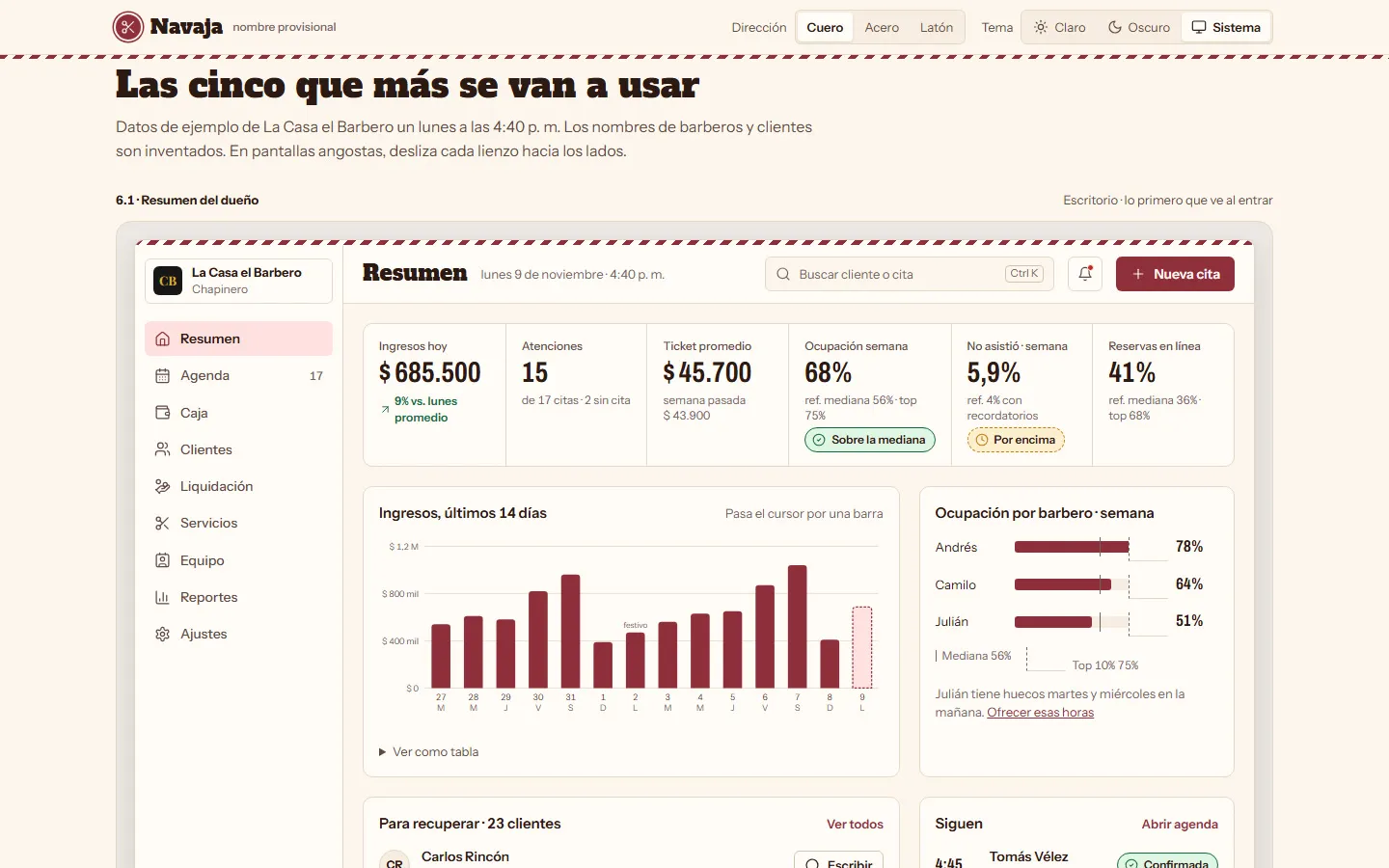
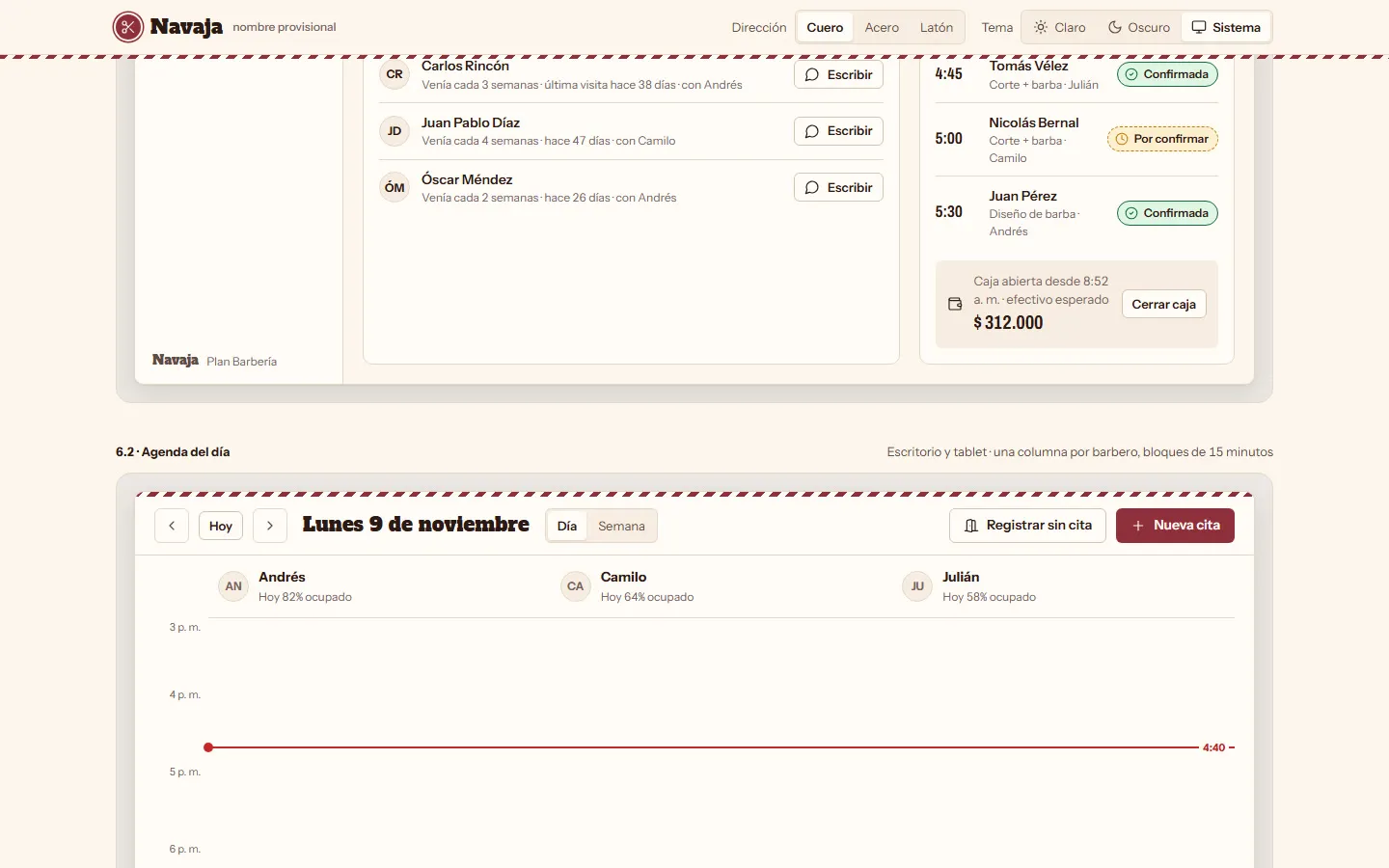
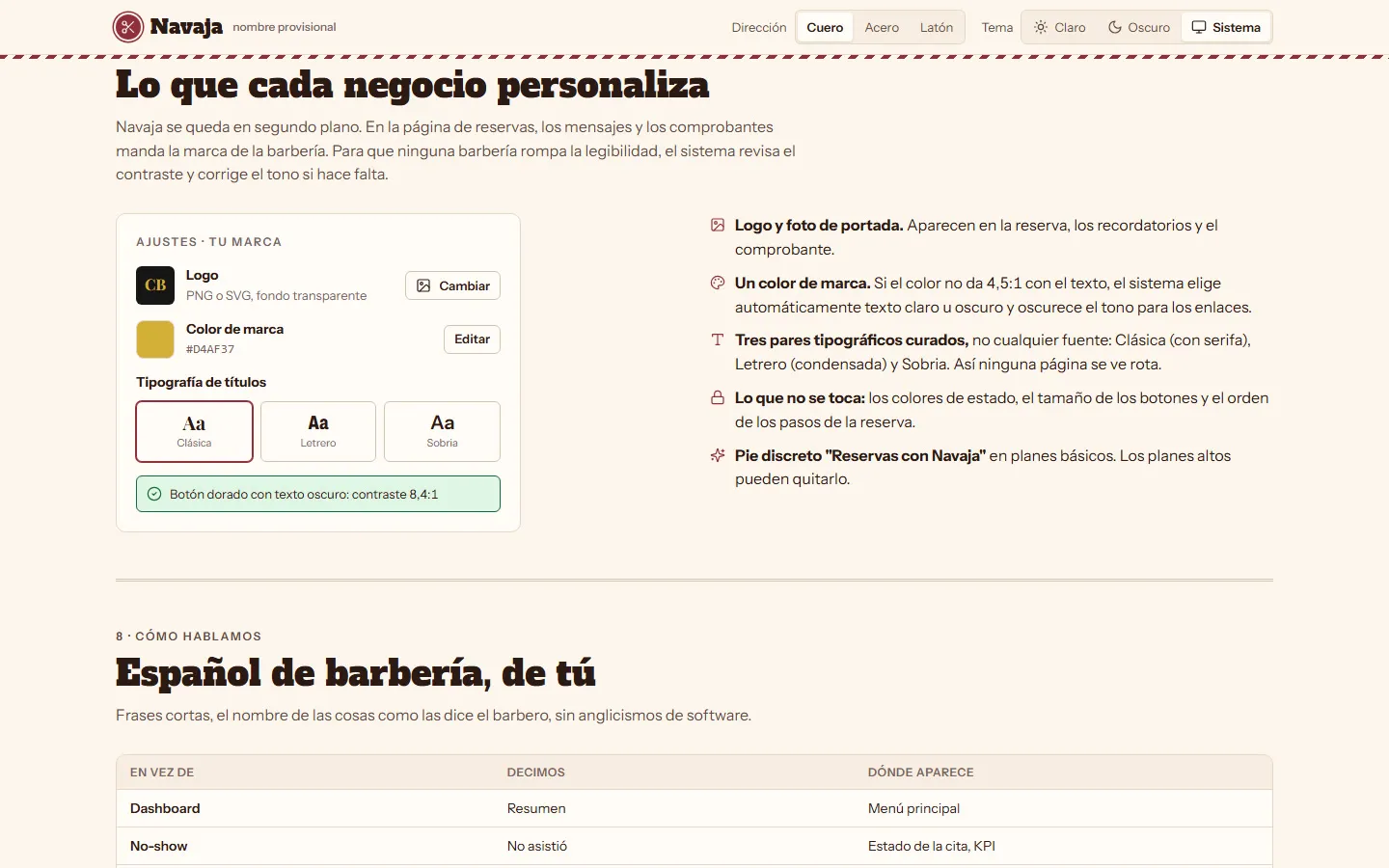
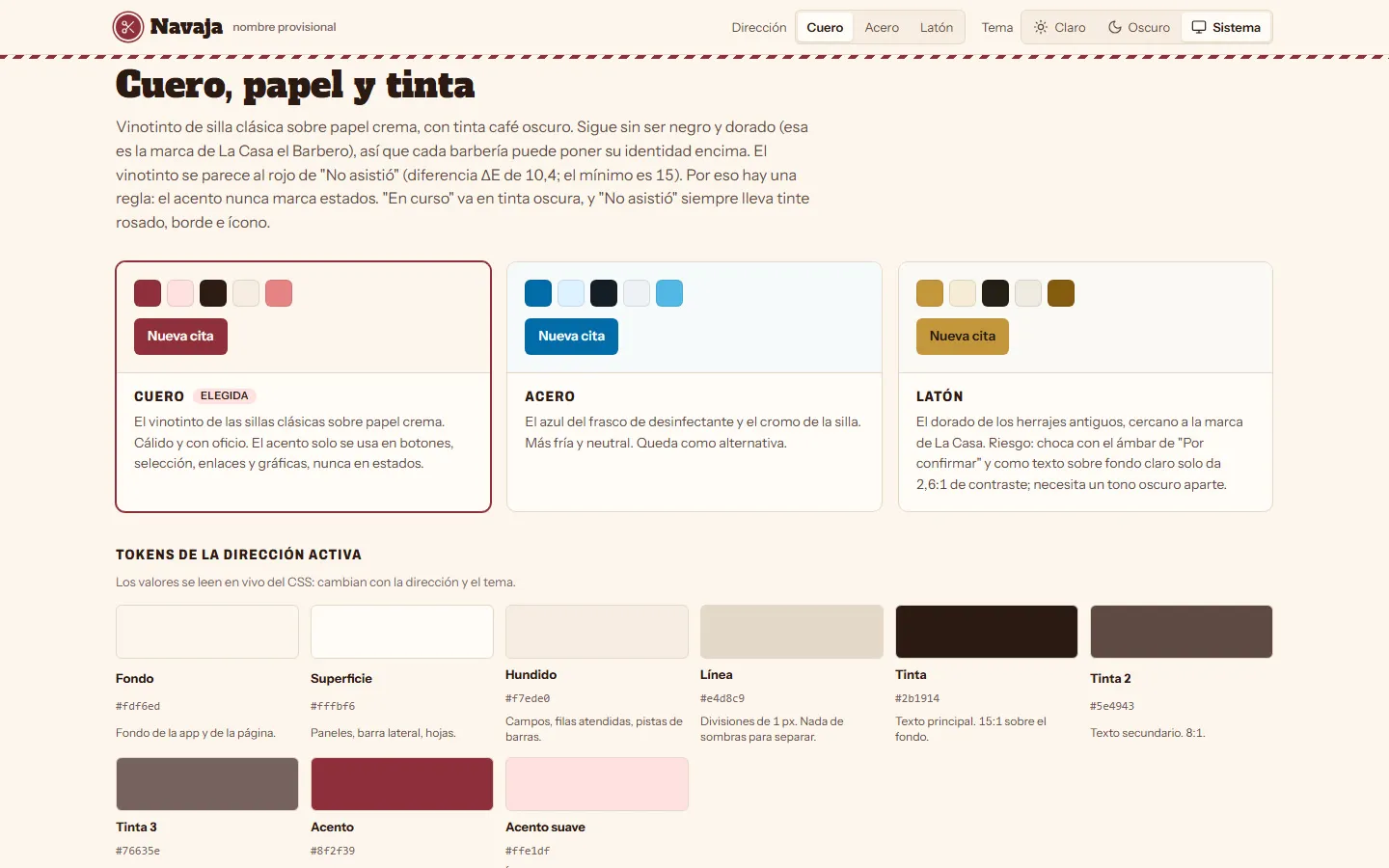
Walkthrough of the SaaS visual system: palette, components and the most-used screens, with sample data (in Spanish).
What it looks like


Architecture
High-level view of the pieces and how they connect.
- Client
Installable web app
React 19 with Vite and Tailwind, the same stack as the website. Works as an app on the barber's phone and the front desk tablet.
- Data
Multi-barbershop
Supabase with PostgreSQL. Each barbershop only sees its own information.
- Messaging
WhatsApp
Meta's official API. Each barbershop connects its existing number and keeps chatting from its phone.
- Automation
Appointment engine
Job queue and scheduled tasks inside the backend: confirmations, reminders and customer win-back.
- Payments
Colombian register
Nequi, Daviplata, Bre-B, PSE, card terminal and cash in a single register.
- Dashboard
Indicators
Revenue, average ticket, chair occupancy, online bookings, no-show and retention.
How I used AI
What AI did, what I decided and how I checked that it works.
01
What AI did
- Market research with sources: industry size, competitors, pricing, hidden costs and industry benchmarks.
- Drafts of the MVP scope, the automations and the design system.
- Built the website and the visual prototype of the SaaS.
02
What I decided
- The positioning: no commission per new customer, WhatsApp at real cost, Colombian payments and transparent payouts.
- That the appointment engine is deterministic; AI does not invent time slots and will only join later for open questions.
- The scope of the first version, what comes later and how to measure the pilot's success.
03
How I verified it
- Every research figure carries its source and a warning when it comes from a vendor.
- Contrast and status colors checked for people with color blindness.
- The website tested on phones of different sizes.
The website
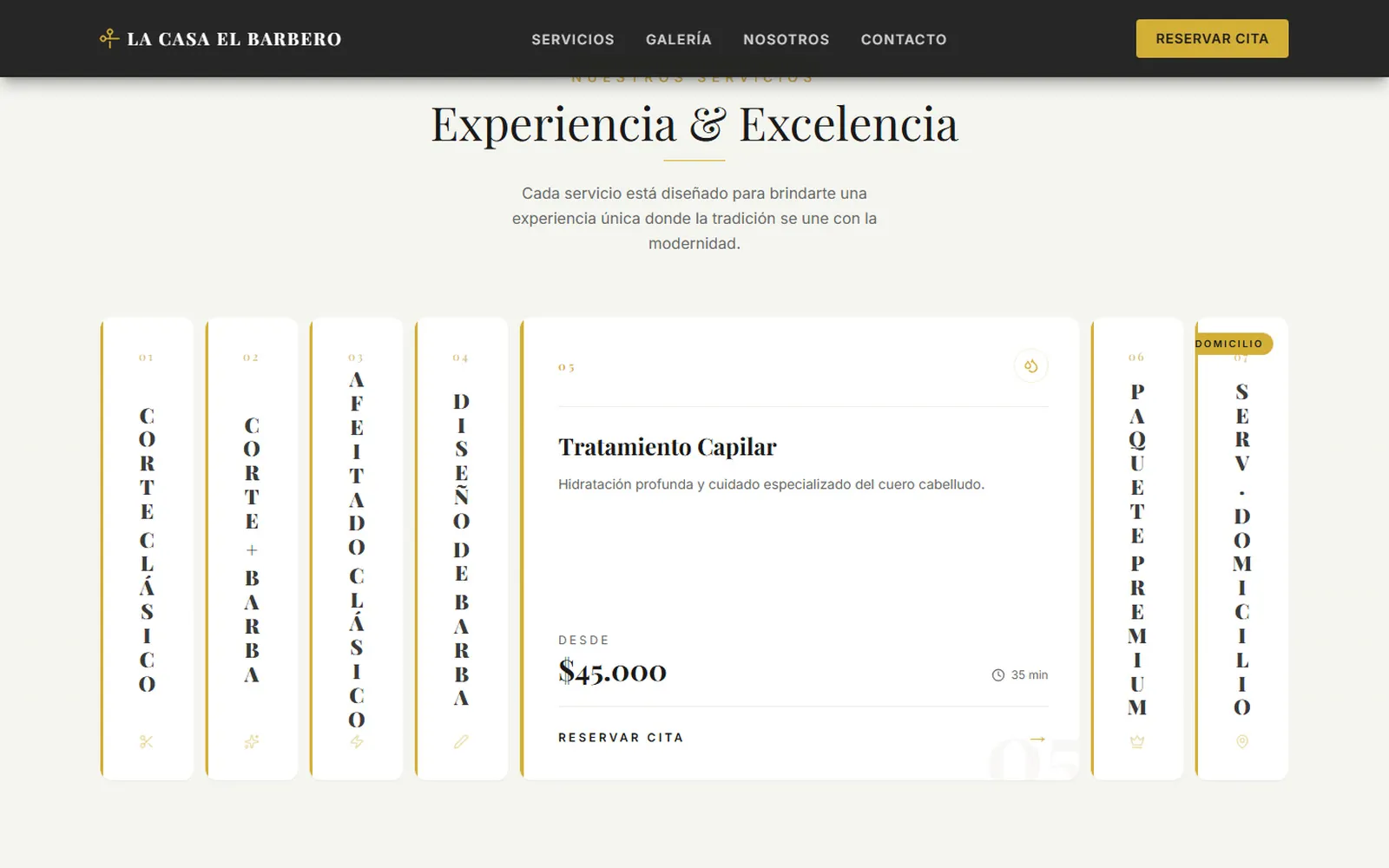
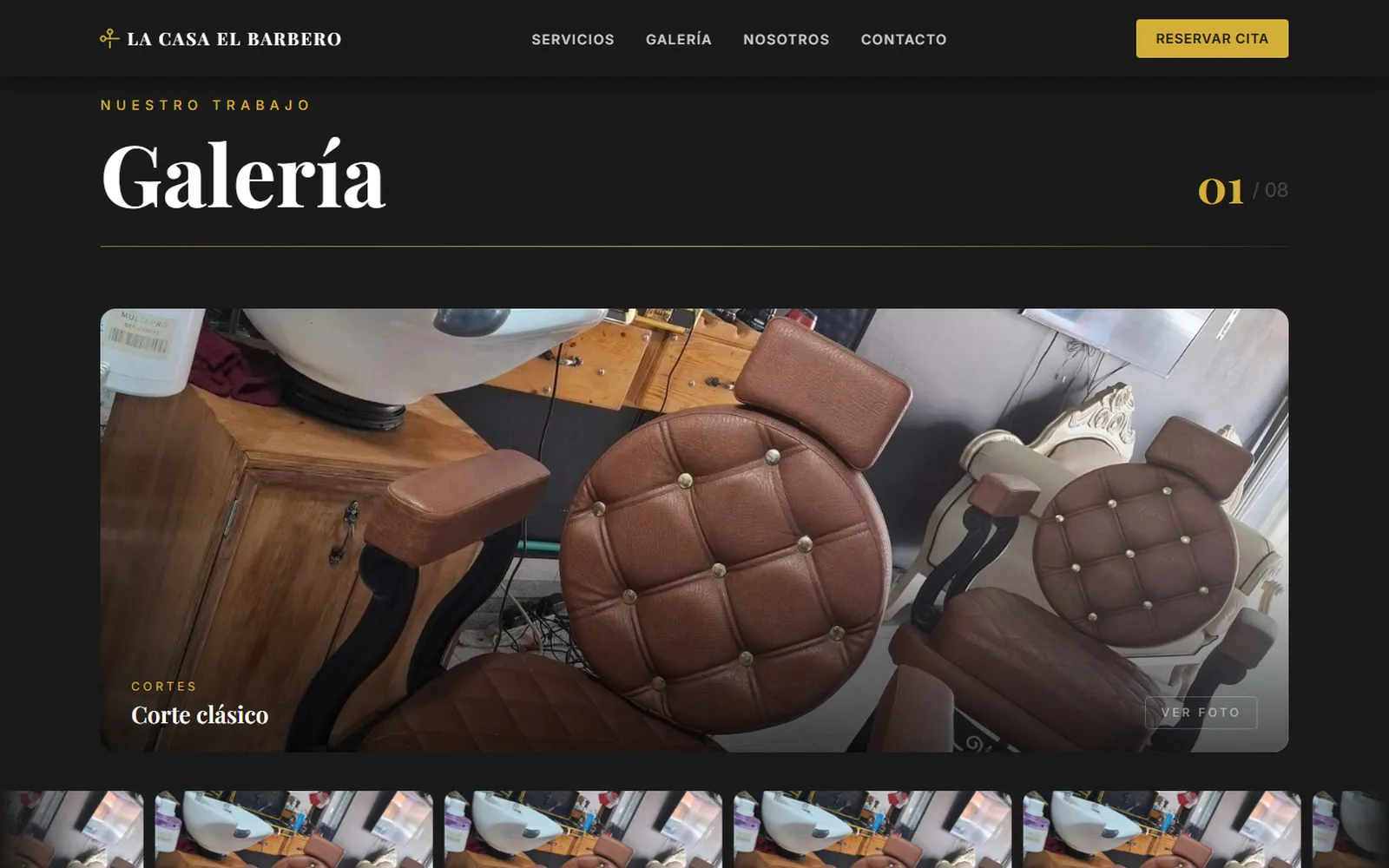
A website that conveys the shop’s tradition, with black, gold and classic typography, and steers everything toward a single action: booking an appointment. Services with prices, gallery, story, testimonials and contact, with animations that feel like a premium barbershop without sacrificing loading speed on mobile.
The SaaS: from research to design
What the research found
- The Colombian market is huge, fragmented and mostly informal: almost all are micro-businesses.
- Regional leaders and global marketplaces charge extra for everything, or take a percentage of each new customer’s first service; that commission is the number one complaint in their reviews.
- A WhatsApp reminder costs Meta about 3 Colombian pesos; some competitors resell it for about 200.
- No software solves together what matters most in Colombia: walk-in queues combined with appointments, home services, mixed barber payouts (commission, salary or chair rent) and WhatsApp at real cost.
- A barbershop’s key indicator is not acquisition but retention: most customers return every 2 to 5 weeks, and the system must alert when someone breaks their rhythm.
Total automation
The design rule is that the barbershop has no chores: customers book, confirm, reschedule or cancel on WhatsApp without anyone replying, and barbers just confirm with one tap when paid in cash. In-chat booking uses native WhatsApp forms with live availability.
Roadmap and pilot
Foundations, scheduling, cash, payouts, customers and dashboard, in that order, followed by a two-month pilot at La Casa el Barbero with clear goals: half of appointments booked online, under 8% missed appointments, closing the register in under 10 minutes and payouts with no disputes.
The SaaS is in design: it exists as research, a spec and a visual system with sample data. It is not a launched product yet.
What I learned
Working with a real business changes the question. It is not “what website do they need” but “what eats their time every day”. The website attracts customers; the software gives the owner their hours back.