Dojo SDD
An environment inside Claude Code to go from junior to senior by solving realistic tickets with spec-driven development, with a tutor, graders and a live dashboard.
- My role
- Method design, development and content
- Stack
- Claude CodePython 3.12PytestJavaScriptHTML and CSS
- AI in the project
- Claude CodeSkillsSubagentsHooks
The problem
With AI anyone can generate code, but that does not teach you to work on a real team: understanding someone else's code, specifying before building, testing and defending decisions in a review. Traditional courses do not teach how to direct an AI with a method either.
The solution
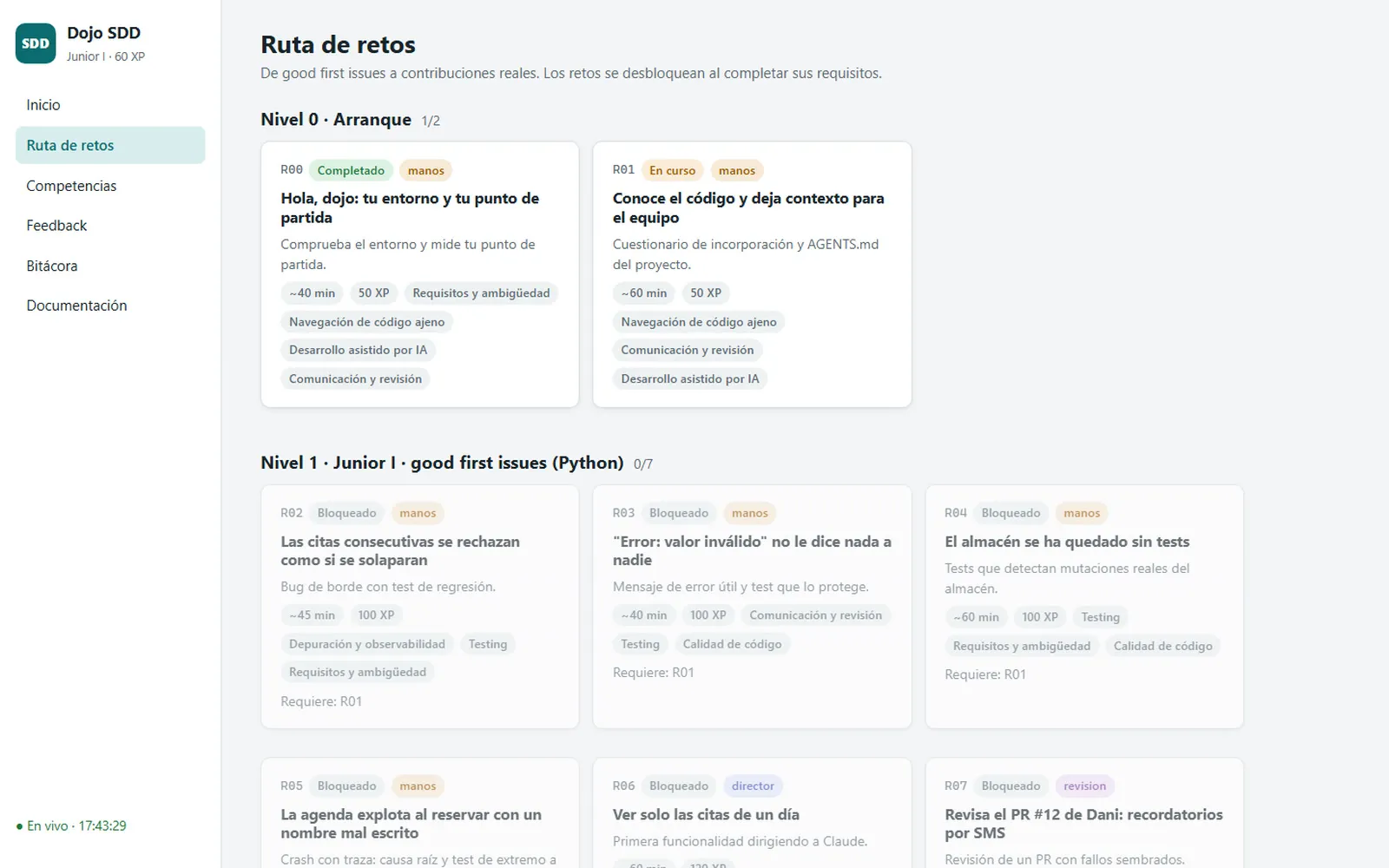
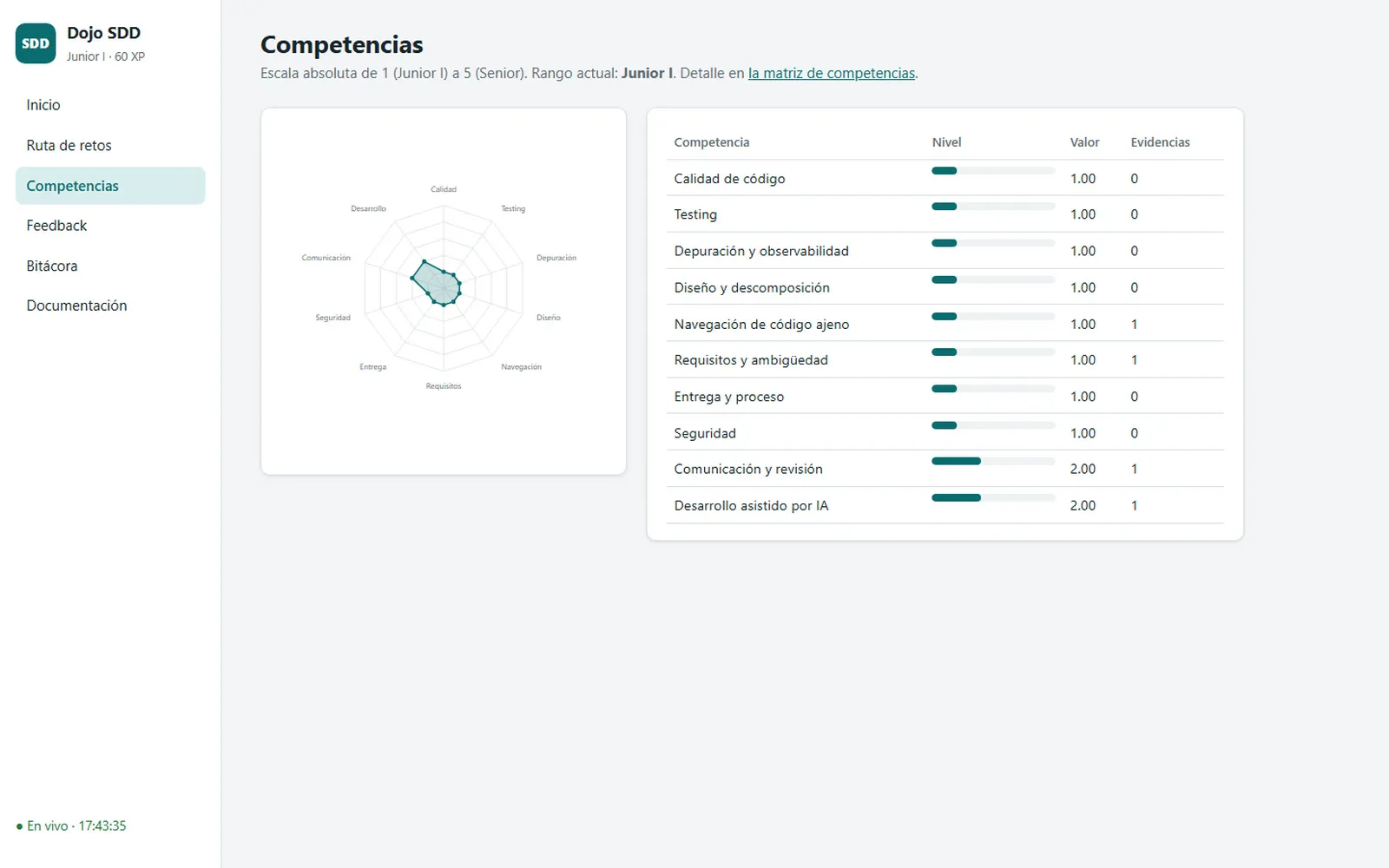
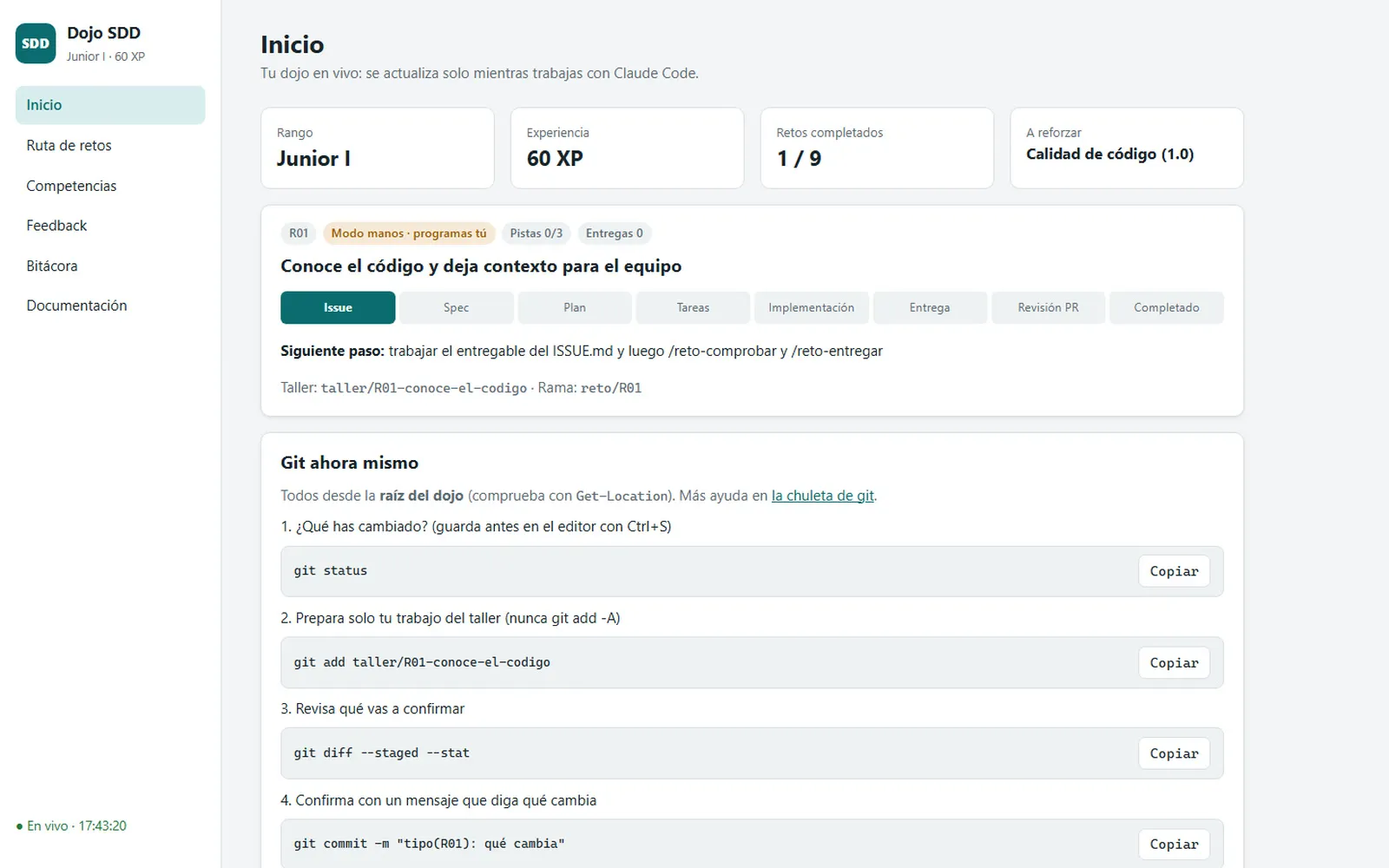
A dojo that lives inside Claude Code. Each challenge is a realistic ticket on a project that grows from a CLI to a web app. Claude acts as a tutor: it enforces spec-driven development, prevents skipping steps, gives hints that cost points and grades ten competencies with evidence. A local dashboard shows progress live.
By the numbers
- 16Custom commands (skills) for each workflow phase
- 4Subagents: grader, senior reviewer, QA and spec reviewer
- 9Challenges across levels 0 and 1, with a level boss
- 82Automated tests for the dojo and the practice project
What it looks like
Architecture
High-level view of the pieces and how they connect.
- Tutor
Claude Code
Custom tutor output style and a status line with challenge, phase, rank and experience.
- Workflow
Skills
Commands to specify, clarify, plan, split into tasks, implement test-first and validate.
- Grading
Subagents
Read-only: they grade with evidence, review like a senior and QA the spec.
- Method
Hooks
Guards that enforce the method's phases and log tests, commits and progress.
- Interface
Local dashboard
Dependency-free Python and JavaScript server: path, competencies, feedback and log.
- Practice
Appointments project
A product that grows from a CLI to a web app, with its own test suite.
How I used AI
What AI did, what I decided and how I checked that it works.
01
What AI did
- Generated much of the commands, hooks and dashboard from a written design.
- Drafted the challenges, which I then adjusted to be realistic and gradable.
- Wrote tests for the dojo itself, including tests for the method guards.
02
What I decided
- The method and its phases, inspired by MoureDev's SDD course, CS50, CodeCrafters and Exercism.
- That in practice mode Claude never writes the solution, and how to detect it.
- The ten competencies, the rank scale and the cost of each hint.
03
How I verified it
- 82 automated tests with Pytest.
- I played the challenges end to end in all three modes (practice, direct and review).
- Grader subagents cannot edit files; they only read and justify.
Technical challenges
A tutor that does not do your homework
The most interesting challenge was getting an AI to teach without solving. In practice mode, one guard checks every action before it runs and another, at the end of each response, detects whether solution code slipped in. The tutor can explain, ask questions and give graded hints, but the person writes the code.
Grading with evidence
A score without evidence is useless. The grader reviews test history, commits and the spec, and justifies every score per competency. Progress reflects what was actually done.
Three ways to practice
The same challenge can be done by coding, by directing Claude with approvals at each phase, or by reviewing a pull request the way a senior engineer would. Each mode changes what the guards allow.
Results
- 9 playable challenges across levels 0 and 1, with the next levels in progress.
- A live dashboard that turns work in Claude Code into visible progress.
- It is the foundation of my own AI workflow, the same one I apply to client projects.
What I learned
Building tools for AI teaches as much as building with AI. Designing guards, permissions and graders forced me to decide which parts of the work must stay human, and that answer is what lets me work faster today without losing control.